General Debugging
If you are having issues with AnythingLLM, the first thing you should do is check the logs. You can find the logs in the logs folder of your AnythingLLM storage - which you can find on your computer using this guide.
App info modal
Click the version number in the top right corner of the app to open the app info modal.
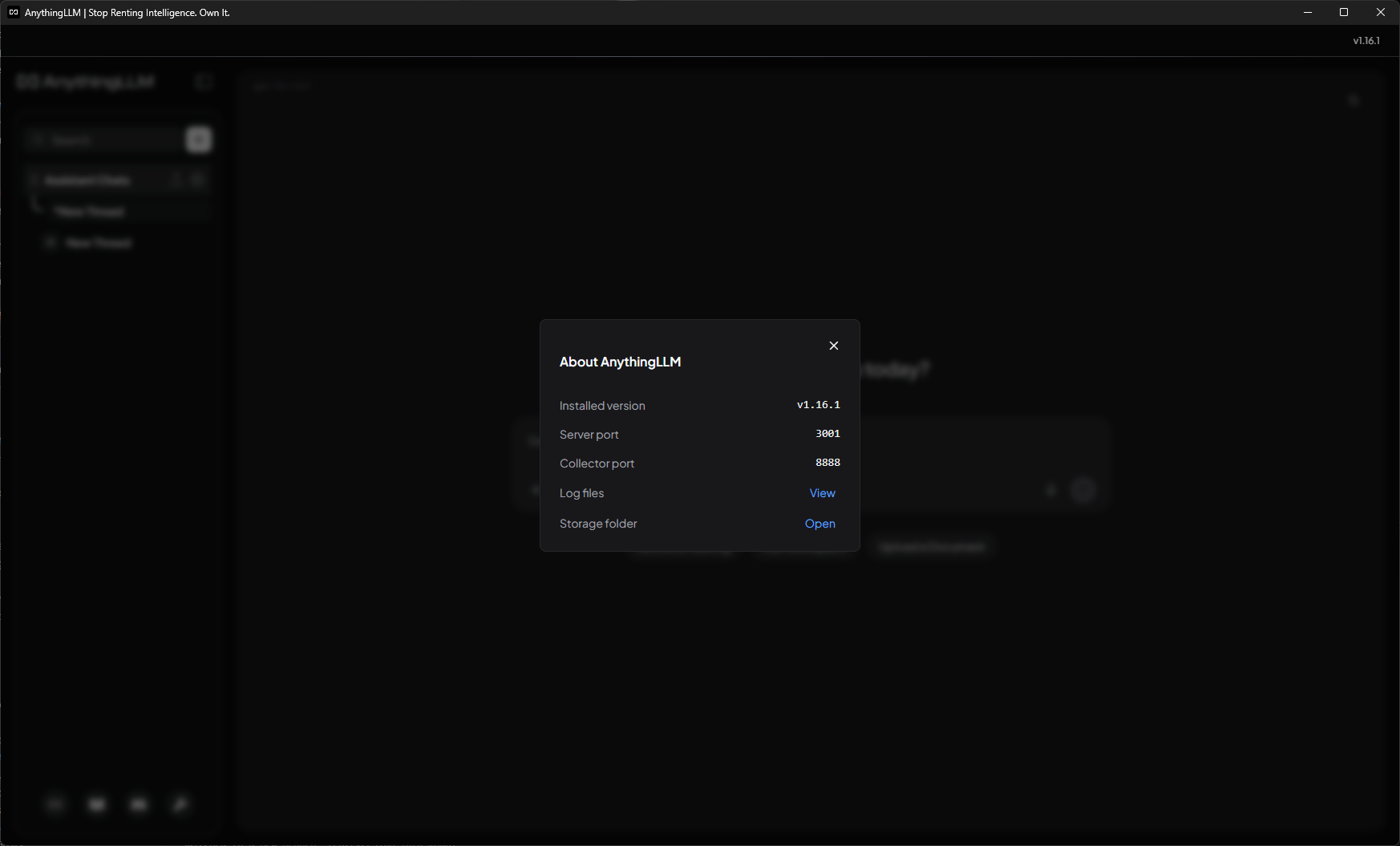
It shows:
- The installed version and the latest available version. If an update is available, a banner links to the download page.
- The local ports the API server and document collector are running on.
- Open logs - opens the
logsfolder in your file explorer. - Open storage - opens the AnythingLLM storage folder in your file explorer.
This is the fastest way to find your logs and storage folder when reporting an issue.
Why is the Desktop application unresponsive while AnythingLLM Docker is running?
AnythingLLM Desktop and the default AnythingLLM Docker setup both use port
3001 by default on your computer. Running both at the same time can sometimes cause a port
conflict that prevents the Desktop application from accepting text input or
opening its menu.
Stop the AnythingLLM Docker container before using the Desktop application. If you
need both running at the same time, map Docker to another available host port.
For example, change the port mapping in the
local Docker run command from
-p 3001:3001 to -p 3002:3001, then open the Docker instance at
http://localhost:3002.
AnythingLLM Debug mode on MacOS
To run the AnythingLLM Application in debug mode (if you are getting errors) you can open a Terminal and navigate to ~/Applications/AnythingLLM/Content/MacOs where you can then run the executable and see all application logs while running AnythingLLM.
AnythingLLM Debug mode on Windows
To run the AnythingLLM Application in debug mode (if you are getting errors) you can open a CMD or Powershell window and run the path to the AnythingLLM executable. Typically this is in C:\Users\usr\AppData\Local\Programs\anythingllm-desktop\AnythingLLMDesktop.exe.
This will print all logs to the powershell window while running and should display a verbose error once encountered that is critical for debugging.
AnythingLLM Debug mode on Linux
To run the AnythingLLM Application in debug mode (if you are getting errors) you can open a Terminal and navigate to ~/.config/anythingllm-desktop/AnythingLLMDesktop.AppImage where you can then run the executable and see all AppImage logs while running AnythingLLM.